Our aim is to program the growth of the nation’s cultural potential by developing children’s speech, curiosity, comprehension of what they read and interest in reading from preschool age.
Daily reading with an adult must be available to every child regardless of parents’ employment, family income or whether there is a home library. Methodological recommendations cannot by themselves establish a universally binding legal norm. We insist on clearly enshrining daily reading with children in regulations. [11]
Why we must act now
Almost half of Ukrainian 15-year-old participants in PISA 2025 (45%) did not reach the baseline level of reading literacy. The study covered 17 of Ukraine’s 27 regions. These students lack the ability to understand and use what they read; knowing the letters alone is not enough for that. [1]
Today’s teenagers need help right now. But their preschool years cannot be brought back. Every year of delay, kindergartens send out another generation of children without guaranteed daily reading. Childhood does not wait for approvals.
We must start in preschool so that future generations grow up with an interest in reading. Kindergartens can organize daily reading and check that it is happening, without waiting for the habits of every family to change. Reading gives the joy of discovery. Its benefit is not limited to preparing for school. Shared reading with an adult enriches vocabulary and develops speech, imagination, memory, sustained attention and the ability to understand and reflect on what has been read. Through stories a child learns to ask questions, express their own thoughts, understand the feelings and actions of others, empathize and look for answers. Shared reading strengthens the emotional bond with the adult, awakens curiosity and builds an interest in books. This experience helps a child prepare for further learning, think independently and keep an interest in discovery. [5, 15, 24]
We urge the Cabinet of Ministers of Ukraine to adopt the following decisions
1. Adopt, within its powers, regulations that oblige preschool education institutions to organize daily live read-aloud and discussion of books in every group on the days it operates, regardless of the institution’s form of ownership. Define the conditions of implementation for in-person and remote work, short-stay care and special kindergartens. Instruct the Ministry of Education and Science of Ukraine (MoES) to prepare the necessary amendments to the relevant acts and to the State Standard of Preschool Education, taking into account the autonomy of institutions and educators. If necessary, prepare and submit the relevant draft laws to the Verkhovna Rada of Ukraine. Designate those responsible for implementation and set deadlines for the relevant regulations to enter into force, in line with the requirements of the law. A methodological letter or an instruction to “look into the issue” shall not be considered fulfilment of this demand.
2. Organize daily reading within the group’s daily schedule and educators’ paid working time, without lengthening their working day. The educator independently chooses the books, the duration and the way of working, taking into account the children’s age and needs. Involve children without coercion and without checking reading technique. Screens and apps must not replace the book and live interaction. Remote communication and accessibility tools should support this interaction.
3. Provide children with books, including in formats accessible to children with special educational needs. Use existing resources and replenish institutions’ collections according to their needs. Do not allow compulsory charitable contributions or mandatory earmarked fees from parents for books for daily reading. The institution and its founder are responsible for access to reading, regardless of family donations.
4. Designate those responsible for implementation and provide for evaluating the actual daily reading practice and its results. The demand shall be considered fulfilled when the institution organizes reading with children every day. Prepared documents alone are not enough for this. Evaluate effectiveness on representative samples of institutions and children, without introducing new daily logs or photo and video reports from educators.
Daily reading must become an obligation of the institution. We must start now.
Below we explain the petition’s demands and give research, practical examples and regulatory grounds.
Rationale for the petition
The PISA 2025 results cited in the petition show the scale of the problem among 15-year-old participants. It did not appear yesterday. The pandemic and the full-scale war made learning harder, but difficulties with reading existed before. [1, 3] PISA data do not make it possible to assess separately the effect of preschool reading. They show that developing reading literacy takes a long time.
School and home have de facto become digital zones. An order cannot change the digital habits of all schoolchildren and parents; restricting smartphones in lessons does not govern leisure at home. Short videos and the endless feed offer a quick reward. We see in this a risk of crowding out reading and of getting used to “clip thinking”, that is, switching between fragments instead of concentrating on the content. The expressions “cheap dopamine” and “clip thinking” are used as journalistic metaphors, with no medical meaning.
Studies of the link between screen time and child development give mixed results. In particular, researchers find links between screen use and preschoolers’ reading practices, and in one study of schoolchildren, social media use was linked to a small increase in inattention symptoms. These data do not prove that any screen causes ADHD or that digital entertainment alone explains the PISA results. [12, 13, 25, 26]
We propose to guarantee children daily time in kindergarten for reading books and talking with an adult.
Why kindergarten in particular
A kindergarten with in-person operation is the only managed analog zone. The head sets the daily routine, and educators organize the children’s day. This is where regular time can be set aside for a book, accessible formats chosen and practice evaluated without interfering in families’ habits at home. This obligation would apply to the institution’s pupils. For children who do not attend kindergarten, support for families and libraries must be provided separately.
Preschool age is especially favorable for preparing for future learning. In the early years the brain is highly plastic, and experience and responsive interaction influence the development of its neural connections. [14] By “programming” the brain we mean daily reading and dialogue that help a child develop skills and an interest in discovery. Kindergarten makes it possible to make this experience regular, regardless of how many books a family has.
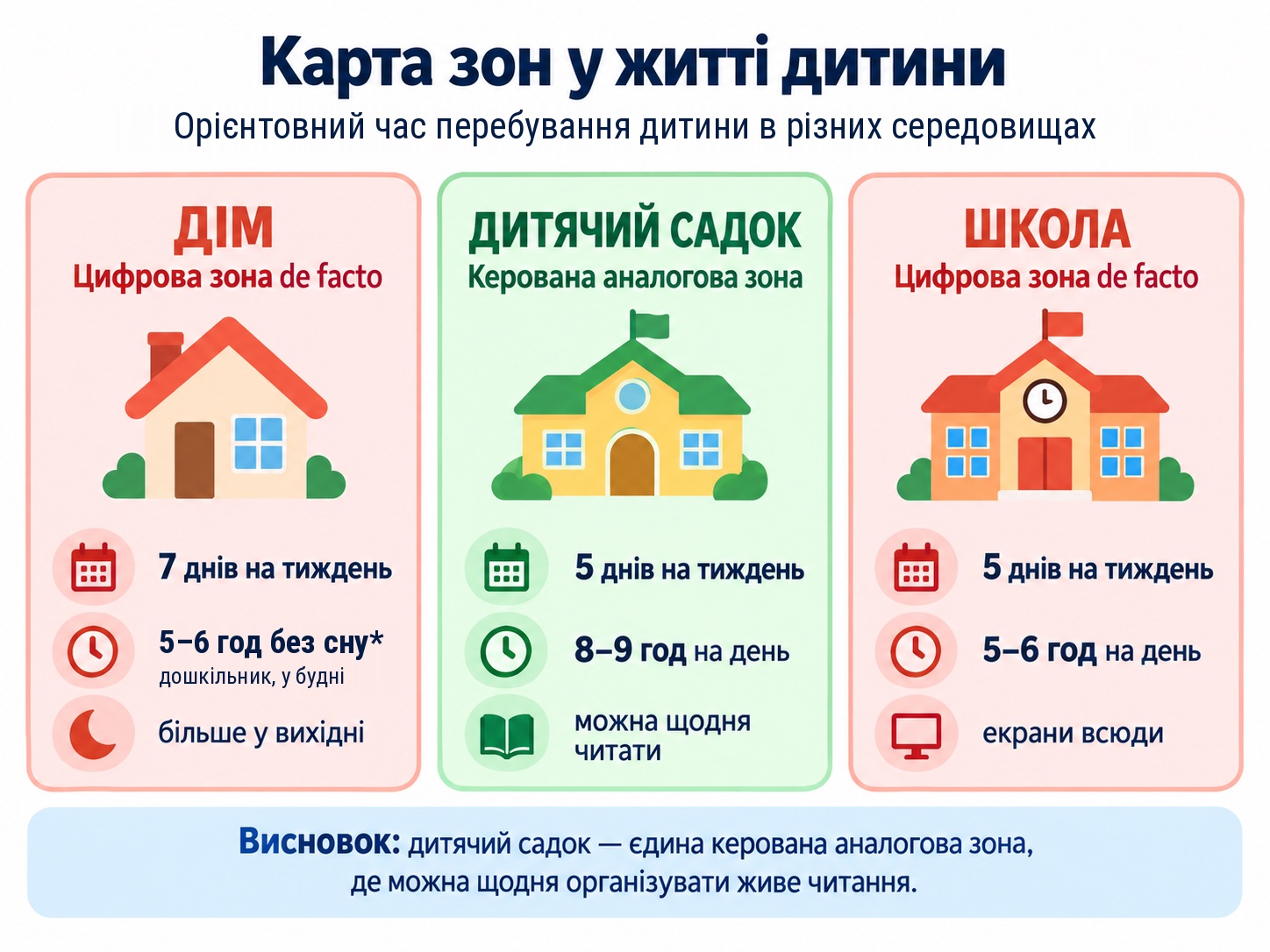
The diagram gives illustrative examples, not statistical averages. *For home, the preschooler’s waking time on weekdays is shown. Kindergarten and school correspond to different age stages, so their hours are not added together. Time spent in the digital environment is not the same as screen time.
How shared reading works
The educator reads aloud, shows the illustrations, pauses on unfamiliar words, and asks what happened to the characters and why they acted as they did. The children guess how the story continues, return to what has already been read and connect events with one another. [5, 9, 15]
A child can ask again, object, propose their own version. By discussing a story, a child learns to express themselves coherently, understand another point of view and concentrate on the content. This does not require sitting motionless. [15, 24] Studies show the benefit of this practice, but they do not establish a single duration for a session or a universal method for every age group.
Accessibility and special kindergartens
Live reading means direct interaction between a child and an adult around a book, including using Ukrainian Sign Language, augmentative and alternative communication and assistive devices according to the child’s needs. Digital tools are used to make reading and communication accessible. Watching entertainment content does not replace this interaction.
For special kindergartens, the Regulation approved by Resolution of the Cabinet of Ministers of Ukraine No. 817 of 7 July 2025 must be taken into account. It provides for forms, methods and means of learning suitable for the child and an individual development program. [11] The organization of reading is aligned with this program and with the recommendations of the psychological and pedagogical support team. Where needed, tactile books, enlarged print, communication cards, one-to-one interaction or small subgroups are used.
The institution is obliged to make reading accessible to every child without requiring the same response from everyone. A child may respond with a gesture, a glance, a choice of picture or another accessible means; a spoken answer is not a condition of participation. Reading does not replace the correctional and developmental services provided by the individual development program and must not increase the workload beyond what the child can manage.
An example of a daily reading routine
In the first half of the day the educator sets aside 15–30 minutes for active reading with discussion.
Before the daytime nap, 5–10 minutes of quiet listening can be provided. The educator reads a short story without a specially organized discussion or any requirement to answer; the children listen as they get ready to rest.
The educator chooses the length and number of episodes according to the children’s age and needs. The durations given are approximate and are not a standard. Listening before sleep does not replace reading with discussion. In short-stay groups, time for reading is provided within the children’s actual stay, without mechanically transferring the full-day schedule.
During an air raid alert, the priority is to move to the shelter and ensure the children’s safety. Once settled in the shelter, reading can continue if conditions and the children’s state allow; otherwise the educator moves it to another safe time.
Economics: start with existing resources
Educators already work and are paid, and some kindergartens have book collections. First of all, time for reading must be provided within paid working hours, without lengthening educators’ working day. Society already pays for educators’ time, and it should work for children’s development. Where books or accessible formats are lacking, founders must separately assess needs and ensure collections are replenished.
Funds may be needed to prepare the regulatory framework, organize accessibility and evaluate results. The needs and sources of funding should be determined by the MoES and the founders of institutions within their powers; costs should not be assumed to be the same for all kindergartens.
Where books are lacking, we call on conscientious parents, caring citizens and socially responsible business to help voluntarily with books, their purchase or delivery. One donated book can serve a whole group. Help does not replace the founder’s responsibility and cannot become a condition of a child’s participation. We must start now with the books we have, while replenishing collections and preparing the necessary decisions in parallel.
Regulatory changes and division of responsibility
When preparing regulatory changes, the following must be taken into account: the Regulation approved by CMU Resolution No. 818 of 7 July 2025, the Regulation on a Special Kindergarten approved by CMU Resolution No. 817 of 7 July 2025, and the relevant MoES acts on in-person and remote forms, in particular Order No. 926 of 26 June 2025. The relevant amendments to the State Standard of Preschool Education are prepared by the MoES for approval by the Cabinet of Ministers of Ukraine under the procedure of Article 42 of the Law of Ukraine “On Preschool Education”. [11]
The changes must preserve the autonomy of institutions and the academic freedom of educators guaranteed by law. If amendments to the law are needed to introduce the obligation, they should be prepared. Subordinate acts must not narrow these guarantees. The norm should define the obligation to read every day. The choice of books and the way of reading remain with the educator. The MoES prepares the regulations and the evaluation methodology. Founders provide resources, heads organize the work, and educators read and talk with the children directly. Accessibility and remote communication tools should help reading and communication. Entertainment screen content cannot replace them.
The State Standard, approved by CMU Resolution No. 1557 of 26 November 2025, enters into force on 1 September 2027. Part two of Article 42 of the Law of Ukraine “On Preschool Education” provides that a new standard, its new version and amendments to it enter into force no earlier than one year after approval. We propose to organize daily reading within the current educational programs and to prepare the regulatory changes in parallel. [11]
A related problem: advertising of digital entertainment
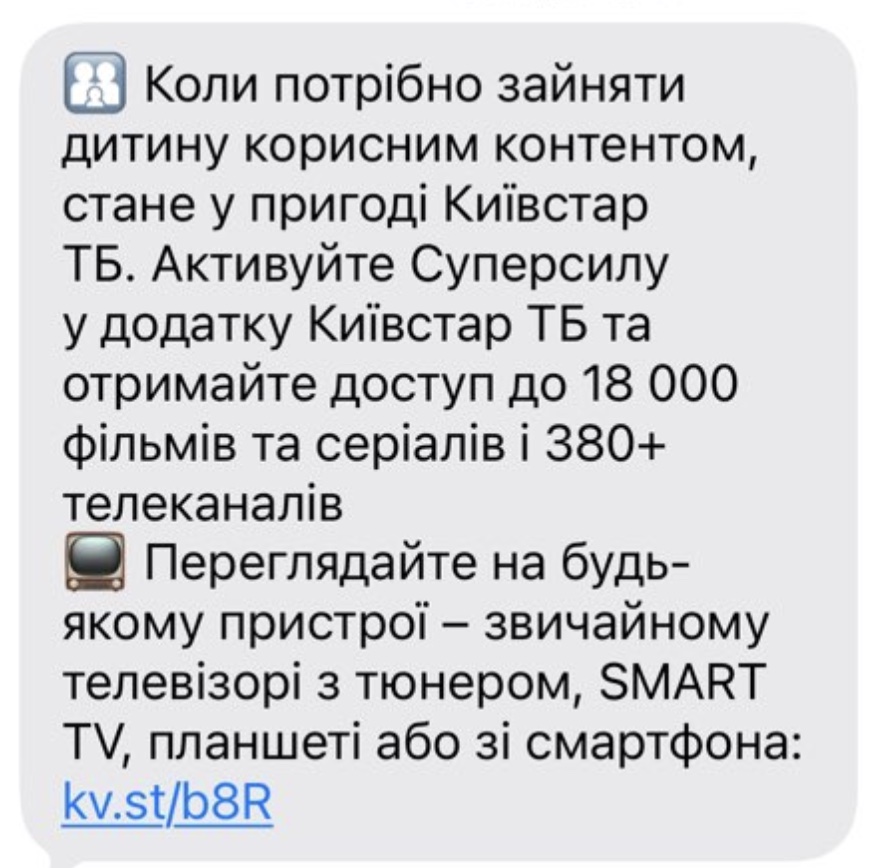
A text message advertising “Kyivstar TV”, received by the author of the petition, offers a service “for when you need to keep a child busy with useful content”: 18,000 films and series and more than 380 TV channels on various devices, including a smartphone. [37] In this example, digital leisure is advertised to parents as a way to occupy a child. Digital content can keep a child busy, but it will not replace an adult’s attention.
We consider such promotion socially irresponsible and propose to discuss separately the legal limits on advertising that encourages replacing an adult’s attention with digital entertainment. The Law “On Advertising” already contains special provisions protecting children; new restrictions need clear criteria, an analysis of current regulation and a procedure for oversight. [38] This is a separate legislative initiative that falls outside the subject of this petition and must not delay the introduction of daily reading.
Key performance indicators (KPIs)
First we expect changes in children’s daily lives, habits and skills, later in learning outcomes, and in the longer term in scientific and cultural achievements. The time frames in the table are counted from the start of implementation.
Horizon | Indicator | Expected change |
|---|---|---|
First year | Time with books and daily regularity | The average number of hours of live reading, listening and discussion per child per week rises. Reading takes place every day in all operating groups. |
First year | Demand for children’s books and their use | The number of children’s books purchased rises. Kindergarten collections are replenished and the number of library loans rises relative to the number of children. |
First year | Entertainment screen time | Time spent passively consuming digital entertainment falls. In kindergarten this time is assessed on a sample basis. At home it is assessed with families’ voluntary participation. |
2–5 years | A lasting reading habit | The share of children who choose books themselves, ask to be read to and, once they learn to read, read on their own initiative rises. The habit persists after the move to school. |
2–5 years | Comprehension and attention | Children better understand what they hear and read, enrich their vocabulary and sustain attention longer. Changes are assessed on a sample basis among children of the same age. |
9–12 years | Ukraine’s PISA results | The average reading score and the share of strong readers rise; the share of participants below the baseline level falls. Ukraine improves its position among participating countries. |
For evaluation, the MoES must define baseline values of the indicators, comparable age groups and representative samples of institutions. It is advisable to publish anonymized aggregate evaluation results: data on the regularity of practice, the use of books and changes in the relevant skills. Long-term indicators must be tied to the appropriate study cycles; changes in PISA results cannot automatically be attributed to kindergarten reading alone. Such evaluation does not replace state oversight provided for by law. [11]
A generational benchmark: 20 years and beyond
In the coming generations we hope to see new Ukrainian Nobel Prize laureates, Fields Medal winners and recipients of other international scientific and cultural awards. Sooner, we expect achievements by schoolchildren, students and young researchers in olympiads, science competitions and professional prizes. We need an education system and science that allow talent to flourish in Ukraine. This is our long-term aspiration for society. Such results cannot be forecast as the direct effect of a single reading practice.
Scientific and analytical base
Research on reading, development and educational opportunity
A meta-analysis of 19 randomized studies involving 2,594 children aged 1–6 found that programs teaching parents to read picture books together with their children improved the children’s ability to express themselves and to understand speech. [5]
NELI: an evaluation of scaling up a language program in 356 English schools found an advantage equivalent to four additional months of language progress. The program includes broader support than reading aloud. [6]
In Milwaukee, a five-year randomized experiment in 60 elementary schools showed that providing children with books for reading at home improved reading outcomes. The authors estimated the overall effect over five years as equivalent to 25–32% of a typical year of learning progress. [7]
In the Abecedarian experiment, 23% of program participants had a bachelor’s degree or higher at age 30, compared with 6% of the control group. The result concerns a comprehensive early education program; it does not isolate an effect of reading. [8]
In an OECD study in Canada, by age 21, 76% of young people with the highest level of reading literacy at 15 were attending university, against 10% of those whose level was first or lower. The link remained after accounting for socio-economic and other factors. The study links reading proficiency with educational opportunity but does not assess the effect of preschool reading. [4]
By PISA 2025 participants’ self-assessments, 60% of Ukrainian teenagers are interested in many different things, against 73% on average across the OECD. Ukraine’s average curiosity index is −0.32, one of the lowest among participants. This is one more reason to build an interest in discovery from preschool. [1, 2]
International practices in preschool reading
England: daily reading for children aged 3–4
The statutory framework EYFS includes language and literacy development; in its description of educational programs it mentions frequent reading and children’s active participation in stories. Development Matters recommends setting aside time for stories at least once a day for children aged 3–4 and reading together throughout their time in the group. Daily frequency is set out in the guidance and is not a separate legal norm. [9]
Adults are advised to discuss stories and the children’s own thoughts with them, explain unfamiliar words, choose books that children can come to know and love well, and connect their plots with play.9]
Educators are advised to devote time to quality interaction with children and to avoid unnecessary paperwork. The guidance helps educators but does not replace their professional judgment. [9]
China: early reading as part of school readiness
The national Guide to the Learning and Development of Children Aged 3–6 covers health, language, social development, science and art. A separate area of language preparation covers reading and writing. For children aged 3–4 the benchmark is an interest in listening to stories and looking at books; for children aged 4–5 it provides for retelling the main content and understanding the sequence of events; for children aged 5–6 it provides for discussing what has been read, predicting how it continues and making their own judgments. Educators and parents are advised to read together with children, let them choose books and look in them for answers to their questions. These age benchmarks take account of individual differences and do not set identical requirements for all children. [18]
The PRC Preschool Education Law, in force since 1 June 2025, establishes play as the main activity of kindergarten, requires that institutions be supplied with children’s books and that preparation be coordinated with primary school. At the same time, it prohibits bringing school teaching methods and the primary-school curriculum into kindergarten. So early development of language and an interest in reading is not equated with going through the school curriculum ahead of time. [19]
Singapore: bilingual preparation, daily reading and protection from screen leisure
The Nurturing Early Learners educational framework for children aged 4–6 combines language and literacy, early mathematics, discovery of the world, creativity and physical development. Language preparation, in particular, is meant to teach children to read with enjoyment and understanding. The educators’ guide directly recommends making reading to children a daily practice; early literacy includes familiarity with the book, letters and sounds, word recognition and understanding of meaning. [20]
In MOE Kindergarten centers, the Starlight Literacy program helps children learn English and one of the community languages: Chinese, Malay or Tamil. The children work with big books for shared reading, songs, rhymes and games. Weeks of Wonder projects complement this work: children choose a topic, ask their own questions, look for answers together and tell about what they found. [21]
Screen requirements are set separately. Since 1 February 2025, the Code of Practice for preschool settings provides for no screen time for children under 18 months, and allows older children up to six years to use screens only for educational purposes. Institutions are not allowed to show videos, films or other digital content simply to keep children occupied outside programmed activities or during transitions between them. This requirement is binding on the institution. [22]
Families are advised to limit the screen time of children aged 18 months to six years to less than one hour a day outside the institution and not to use a screen merely to occupy or distract a child. This advice for families applies separately from the mandatory rules for kindergartens. [23]
Finland: support for reading work
In Finland, the Lukeva varhaiskasvatus program offers institutions a tool for planning reading work: daily time for books and shared reading, renewal of materials, working time for preparation and cooperation with libraries. The institution itself chooses actions according to its conditions. [10]
Cultural and historical benchmarks
According to Amos Oz and Fania Oz-Salzberger in Jews and Words, every boy was expected to attend school from the age of three to thirteen. This obligation fell on children and parents; the community organized the teaching and often paid for it regardless of the family’s wealth or background. The authors contrast early familiarity with narrative and writing with preparation chiefly for an economic or military role. [36]
“…The Jews, however, instilled a culture of narrative in children as soon as they began to understand words, at the age of two, and to read them, often as early as the venerable age of three. In a word, teaching a child began as soon as it was weaned.”
Amos Oz, Fania Oz-Salzberger. “Jews and Words” (Jews and Words, 2012). Working translation.
The British and Jewish examples: the scale of achievement
For a cultural and historical comparison we give the number of Nobel laureates. For 1901–2025, the named catalog Nobelists.org lists 138 British laureates by the citizenship criterion (about 14% of all individual laureates); JINFO.org lists at least 221 Jewish laureates and laureates of Jewish descent, about 22% of all individual laureates in this period. [16, 17]
These awards serve as a cultural and historical benchmark. They cannot be used to measure the effect of preschool reading. We aim to develop a mass culture of reading and discovery so that every child can reveal their abilities.
How to evaluate results
When counting hours, the time for reading, listening and discussing books should be counted, without formally crediting the time a child spends in the group. The number of books purchased shows demand. This indicator must not be turned into a plan for collecting money from parents. It is also necessary to assess whether children use the books. Data on screen leisure at home can be collected only on a sample basis and voluntarily. They should not be used as a personal KPI for an educator.
The regularity and duration of the practice can be assessed through observation and short surveys using a MoES methodology, without a daily administrative burden on educators. PISA assesses 15-year-old participants. Children who are 3–6 when implementation begins will reach that age in 9–12 years. What should be compared is not only ranking positions but also scores, literacy levels and territorial coverage. [27]
Supporting the child and the family
Familiarity with letters and learning to read independently should be supported already in preschool age, in line with the child’s interest and readiness.
Kindergartens and libraries can help families choose books and lend them for home. Such support must be voluntary, with no compulsory purchases, homework or reading reports.
Analytical appendix
Education spending: an international comparison
In the nominal conversion shown, Ukraine and China have hundreds of dollars of public education spending per resident, while in the other four countries it amounts to thousands. Our conclusion: it is better to use resources that are already paid for, rather than wait for budgets to level out. Daily reading does not replace proper funding of education. [28–34]
The annual data below show the scale of public education funding. The years and the composition of expenditure are noted separately: this is not a ranking of countries on a single methodology. Conversion to nominal US dollars does not account for differences in purchasing power.
Public education spending and the per-resident calculation
Country / year | Public spending, bn national currency | Equivalent, USD bn | Population, million | Per resident, USD |
|---|---|---|---|---|
Ukraine 2024 [28] | 348,4 UAH | ≈8,7 | 31,5* | ≈275 |
Israel 2025 [29] | ≈127,6 ILS | ≈37,0 | 10,178 | ≈3 634 |
United Kingdom 2024/25 [30] | 122,6 GBP | ≈156,6 | 69,281 | ≈2 260 |
China 2024 [31] | 4 149,5 CNY | ≈577,2 | 1 408,28 | ≈410 |
Singapore 2024/25 [32] | 14,430 SGD | ≈10,8 | 6,04 | ≈1 788 |
USA 2024 [33] | 1 372,8 USD | ≈1 372,8 | 340,1 | ≈4 037 |
* For Ukraine, the calculation uses an assumed 31.5 million residents of the government-controlled territory, not a confirmed 2024 population figure. For a range of 31–32 million, the calculation gives about USD 271–280 per resident. For Singapore the total population, including non-residents, is used; for Israel the population at the end of 2025 is taken. [28, 29, 32]
The composition of funding differs. For Israel, the public share of national spending is calculated; for China, the total public budget is taken (broader government funding is 5,416.1 billion yuan); for the USA, current expenditure without capital investment is counted. The bases of the calculations are given in the notes. [29, 31, 33]
Spending per student: different levels of education and units of comparison
Country | Per student per year | Year, units and coverage |
|---|---|---|
Israel [35] | USD 11,166 PPP | 2022. Public spending on education from primary to post-secondary non-tertiary. |
United Kingdom [35] | USD 13,063 PPP | 2022. The same OECD coverage and units. |
USA [35] | USD 14,603 PPP | 2021, in the 2025 OECD edition. The same coverage. |
16 282,98 CNY ≈ USD 2,265 | 2024. Total public budget per student, national average; not a figure for a separate level of education; not PPP. | |
13 953 SGD ≈ USD 10,444 | 2024. Current government spending per primary school student; not PPP, excluding capital spending. |
The OECD series covers public spending on institutions from primary to post-secondary non-tertiary education per full-time equivalent student, in US dollars at purchasing power parity (PPP). China and Singapore have different coverage and currency conversion, so not all rows can be compared directly. [31, 32, 35]
Sources and notes
- OECD, PISA 2025: Ukrainian regions (17 of 27). The figures of 55%, 60% and 73%, the definition of the baseline level and the limits of territorial coverage. 45% is the complement of the 55% figure to 100%.
- OECD, Education GPS: Ukraine, PISA 2025; primary data for Figure I.3.13 of PISA 2025 Results (Volume I). Mean reading scores of 418 and 461; curiosity index −0.32. The GPS gives the same rank, 83/85, for Ukraine and Jordan; the unrounded means in the primary table differ. Only the Palestinian Authority has a lower mean than Ukraine. This comparison of means does not establish the statistical significance of the difference. The index is based on a questionnaire; it is not the share of children who “have no curiosity”.
- OECD, PISA 2018: Ukraine - Country Note. Reading: 466 points in Ukraine, 487 on average across the OECD.
- OECD, Pathways to Success: How Knowledge and Skills at Age 15 Shape Future Lives in Canada, 2010, tables 6.2–6.3. The figures of 76% and 10% are unadjusted descriptive data on university attendance by age 21; level 5 was the highest in the corresponding PISA cycle. A separate analysis accounts for background factors. The study does not establish an isolated causal effect of reading.
- Dowdall et al., Shared Picture Book Reading Interventions for Child Language Development: A Systematic Review and Meta-Analysis, Child Development, 2020. 19 randomized studies, 2,594 children; effects of d = 0.41 for expressive language and d = 0.26 for language comprehension. These are standardized effect sizes, not percentages of improvement. The meta-analysis evaluates programs of shared reading with parents; it does not establish a universal session length or the effectiveness of a specific state program for kindergartens.
- Education Endowment Foundation, Nuffield Early Language Intervention - Reception. In England, the NELI program received government funding for rollout to schools. A quasi-experimental evaluation of scale-up in 356 schools found an average advantage equivalent to four additional months of language progress. A separate follow-up of participants in the randomized trial found benefits in language and reading after two years. The EEF two-year report notes attrition of 55.5% of participants, which limits the reliability of the long-term conclusion. Four additional months of progress and the two-year follow-up are results of different evaluations. NELI includes broader language support than reading aloud. A separate scientific publication: Hulme et al., 2025.
- Borman and Yang, Cumulative access to print books improves literacy achievement: Evidence from a five-year randomized trial in high-poverty schools, PNAS, 2026. In Milwaukee, USA, a five-year randomized experiment in 2018/19–2022/23 covered 60 public elementary schools. Children in 30 schools were given books for reading at home; another 30 schools formed the control group. The overall effect after the five-year intervention was d = 0.100; the authors estimated it as equivalent to 25–32% of a typical year of learning progress. This is not an annual increase in test scores of 25–32%; the study concerns elementary school and shows the benefit of long-term provision of books to schoolchildren.
- Campbell et al., Adult Outcomes as a Function of an Early Childhood Educational Program: An Abecedarian Project Follow-Up, 2012. The American Abecedarian experiment covered an intensive comprehensive early development program for children from low-income families from infancy to age five. At the start there were 111 children, and 101 participants in the follow-up at age 30. At that age, 23% of program participants had a bachelor’s degree or higher, against 6% of the control group. The result concerns the whole early education program: it cannot be attributed to reading alone or automatically transferred to a Ukrainian daily reading program.
- Department for Education, England. Early years foundation stage (EYFS) statutory framework for group and school-based providers, version of 1 September 2026, section 1, pp. 9–11: mandatory requirements for learning and development; frequent reading is included in the description of educational work. Development Matters, Communication and language (ages 3–4), Literacy and the introduction: non-statutory recommendations on daily time for stories, shared reading and prioritizing interaction over unnecessary paperwork. The recommendation of daily frequency should not be equated with a separate legal norm of the EYFS. Ofsted. Early years inspection information: inspection of registered settings for compliance with EYFS requirements.
- Opetushallitus, Finland. Lukeva varhaiskasvatus and a tool for planning reading work. Daily time for shared reading, the institution’s own plan, materials and working time, cooperation with libraries. This is a planning support tool, not a single mandatory methodology.
- Law of Ukraine “On Preschool Education” No. 3788-IX: Article 2, part 2 – methodological recommendations of public authorities are not regulations and cannot establish binding legal norms; Articles 16 and 26 – educational programs and educators’ working time. Legal reference points for implementation: CMU Resolution of 7 July 2025 No. 818 (para. 15 of the Regulation – time and routine of stay) and MoES Order of 21 May 2025 No. 747 on the in-person (daytime) form. The changes must preserve the autonomy of institutions and educators provided for by law. Approval of the state standard is prepared by the MoES for approval by the CMU under the procedure of Art. 42; the new standard under Resolution of 26 November 2025 No. 1557 enters into force on 1 September 2027. Reading within current programs can be organized without waiting for changes to the standard. For special kindergartens, the Regulation approved by CMU Resolution of 7 July 2025 No. 817applies; for the remote form, the Regulation approved by MoES Order of 26 June 2025 No. 926. Part two of Article 42 sets a minimum one-year period before a new standard, its new version and amendments enter into force. State oversight (control) is carried out under Article 49.
- McArthur et al. Longitudinal Associations Between Screen Use and Reading in Preschool-Aged Children. Pediatrics, 2021. In a study of 2,440 children, more screen time at 24 months was linked to less reading at 36 months, and less reading to more screen time at 60 months. The observational design does not prove that screen time is the only cause of reading difficulties. The displacement of reading practice is the starting hypothesis of this initiative, not a causal conclusion established by PISA.
- Putnick et al. Displacement of peer play by screen time: associations with toddler development. Pediatric Research, 2023. In a sample of 3,894 families, screen time of children aged 1–3 was linked to reduced play with peers, but not to time spent reading with an adult. So the research results are mixed. The expression “cheap dopamine” may serve as a journalistic metaphor for quick reward, but the cited sources do not prove a neurobiological “blocking” of the reading skill.
- Center on the Developing Child at Harvard University. Brain Architecture; Serve and Return. Early experience and responsive interaction influence the formation of neural connections and the foundations of language and learning. Plasticity is especially high in the early years; learning and the formation of new connections continue throughout life. “Programming” in the petition is a metaphor for building skills through daily experience.
- American Academy of Pediatrics. Klass et al. Literacy Promotion: An Essential Component of Primary Care Pediatric Practice: Technical Report. Pediatrics, 2024;154(6):e2024069091. A review of evidence on the development of language, comprehension, attention, social-emotional skills, a positive attitude to reading and relationships during shared reading. DOI: 10.1542/peds.2024-069091.
- Nobelists.org. British Nobel Prize laureates. A named catalog by British citizenship, including the historical United Kingdom of Great Britain and Ireland: 138 individuals and 139 awards, including 2025 laureates. Frederick Sanger, who was awarded twice, is counted once as a person. This is a count of the catalog by citizenship, not just by place of birth, work or study. The total number of individual laureates for 1901–2025 is 990 according to the official list NobelPrize.org: 138 / 990 × 100 = 13.94%, rounded to 14%. The British and Jewish counts include the Nobel Memorial Prize in Economic Sciences; organizations are not counted.
- JINFO.org. Jewish Nobel Prize Winners. For 1901–2025, at least 221 individual laureates, about 22% of individual laureates. The list includes Jews and people of half or three-quarters Jewish descent; repeat laureates are counted once. This is not an official classification of the Nobel Foundation. The British and Jewish lists have different criteria and overlap, so their numbers should not be added together. The text uses a cut-off through 2025 inclusive.
- Ministry of Education of the PRC. Guide to the Learning and Development of Children Aged 3–6 (2012), section “Language: preparation for reading and writing”. Full text on the website of the education administration of Haidian District, Beijing: age benchmarks for 3–4, 4–5 and 5–6, shared reading, retelling, discussion and respect for the individual pace of development.
- PRC Preschool Education Law, adopted on 8 November 2024, in force since 1 June 2025. Articles 56–59: play, children’s books, cooperation between kindergarten and primary school; the prohibition of school teaching methods and the primary-school curriculum in kindergarten. Text on the official government portal of Hechuan, Chongqing.
- Ministry of Education of Singapore. Nurturing Early Learners Framework 2022 (ages 4–6); Educators’ Guide for Language and Literacy (English Language), 2023, printed pp. 38–45 and 95. Early literacy goals and a direct recommendation to read to children every day.
- MOE Kindergarten @ Pioneer. The Starlight Literacy and Weeks of Wonder programs: bilingual preparation, big books, songs and games, shared research projects. Description of implementation on the official website of an institution in the Singapore Ministry of Education system.
- ECDA, Singapore. Code of Practice requirements on screen time; changes introduced from 1 February 2025. For children under 18 months – no screens; from 18 months to six years – for learning only. It is not permitted to show digital content to keep children occupied outside programmed activities or during transitions between them.
- Ministry of Health and Health Promotion Board, Singapore. Grow Well SG – Nurturing Healthy Behaviours, HealthHub. Recommendations for families: from 18 months to six years – less than one hour of screen time a day outside the institution; do not use a screen merely to occupy or distract a child.
- Dowdall et al. Book-Sharing for Parenting and Child Development in South Africa: A Randomized Controlled Trial. Child Development, 2021;92(6):2252–2267. DOI: 10.1111/cdev.13619. In a randomized study of 140 children aged 21–28 months, training parents in dialogic reading had a positive effect on language and attention. An improvement in sustained attention was found six months later, but not immediately after the intervention. No positive effect on behavioral problems was found. This is evidence in favor of supporting attention through shared reading, not proof of treating or preventing ADHD.
- Nivins, Mooney, Nigg, Klingberg. Digital Media, Genetics, and Risk for ADHD Symptoms in Children: A Longitudinal Study. Pediatrics Open Science, 2026;2(1):1–10. DOI: 10.1542/pedsos.2025-000922. A study of 8,324 children over four years; average starting age 9.9 years. Social media use was linked to a small increase in inattention symptoms after accounting for genetic predisposition and socio-economic conditions. No such link was found for video games or watching television/video. The study does not prove that any screen causes ADHD and does not measure this effect in preschoolers.
- National Institute of Mental Health. Attention-Deficit/Hyperactivity Disorder (ADHD). Attention deficit hyperactivity disorder is a developmental disorder with persistent symptoms that appear in different life situations; isolated inattention or restlessness is not the same as a diagnosis. “Clip thinking” in the petition describes fragmentary consumption of information, not a medical diagnosis. Supporting attention through reading does not replace professional help for children with ADHD.
- OECD. PISA – Programme for International Student Assessment. General description of the program: PISA assesses 15-year-old students. The 9–12-year horizon for children aged 3–6 at the start is an age-based calculation; verification should be tied to the corresponding study cycle.
- Ministry of Finance of Ukraine. Education spending in 2024: UAH 348.4 billion; state and local spending, without double-counting interbudgetary transfers. Average annual 2024 exchange rate – UAH 40.15 per USD, as calculated by Forbes Ukraine from official rates. The dollar equivalent is 8.677 billion; the population of 31.5 million is a calculation assumption, not census data. No per-student figure is given for Ukraine: data on spending and the number of students that are consistent by year and coverage are needed.
- CBS Israel: 2025 data in a TV10 report of 14 October 2026. The preliminary national total is NIS 162.6 billion; the share of government, local authorities and public non-profit institutions is 78.5%; the calculated public part is 127.641 billion. Population at the end of 2025 – 10.178 million per the CBS as reported by The Times of Israel. More than 2.5 million students in September 2025 – schools and kindergartens, excluding higher education. The primary statistical release on spending was not obtained directly; its media coverage was used.
- HM Treasury. Public spending statistics: May 2026. Education for the whole public sector for the 2024/25 financial year – GBP 122.6 billion; the constant-price base in this release is exactly 2024/25, so for the chosen year the value coincides with the nominal one. ONS: population of the United Kingdom at mid-2024 – 69.2814 million. Here “United Kingdom” means the whole of the UK, not just England.
- MoE, Ministry of Finance and National Bureau of Statistics of the PRC. Implementation of education spending in 2024, announcement No. 5 (2025) of 31 December 2025. Total public budget – 4,149.509 billion yuan; the nationwide average per student – 16,282.98 yuan, not a separate figure for primary school. Broader government funding – 5,416.105 billion, including government funds, contributions of state enterprises and other categories. Population of the PRC at the end of 2024 – 1,408.28 million. Hong Kong, Macao and Taiwan are not included.
- SingStat. Government Expenditure On Education: for financial year 2024 – SGD 14.4300841 billion, current expenditure and development within the published series. Government Recurrent Operating Expenditure On Education Per Student: primary school, 2024 – SGD 13,953 per student, current costs only. Population in Brief 2024: total population as of June 2024 – 6.04 million, including non-residents.
- BEA / FRED. Government current expenditures: Education, G160291A027NBEA. For 2024 – USD 1,372.816 billion, in the version of 30 September 2026. This is current expenditure at federal, state and local levels; not a full total with capital investment. US Census Bureau: population in 2024 – about 340.1 million.
- IRS. Yearly average currency exchange rates. The table uses units of national currency per USD 1: 2024 – GBP 0.783; CNY 7.189; SGD 1.336; 2025 – ILS 3.451. For the United Kingdom and Singapore, the 2024 annual rate is an approximation for financial year 2024/25. Dollar and per-resident amounts were calculated from unrounded source data, and the results were rounded.
- OECD. Education at a Glance 2025: Israel – USD 11,166 PPP; United Kingdom – 13 063; USA – 14,603. Public spending on institutions from primary to post-secondary non-tertiary education per full-time equivalent student. Cut-off – 2022; for the USA an exception on the reporting year (2021) applies. Table C1.1 and notes. This is not the average cost for all levels together, including kindergartens and universities.
- Amos Oz, Fania Oz-Salzberger. Jews and Words. Yale University Press, 2012, chapter “Continuity”. The authors’ description of the norm of educating boys and the role of the community; not a precedent for a requirement identical to the present-day one of daily reading for preschoolers.
- Screenshot of a text message advertising “Kyivstar TV”, received by the author of the petition; reproduced below. An example of promoting screen viewing as a way to “keep a child busy with useful content”.
- Law of Ukraine “On Advertising” No. 270/96-VR: Art. 20 – protection of children in advertising; Arts. 22 and 22¹ – special restrictions on advertising of tobacco products, alcohol and gambling.