

Practical advice
What to read and what to do about screens
How to start, what to ask, which book to take and what to do about screens.
Open advice for parentsCivic initiative · Preschool education
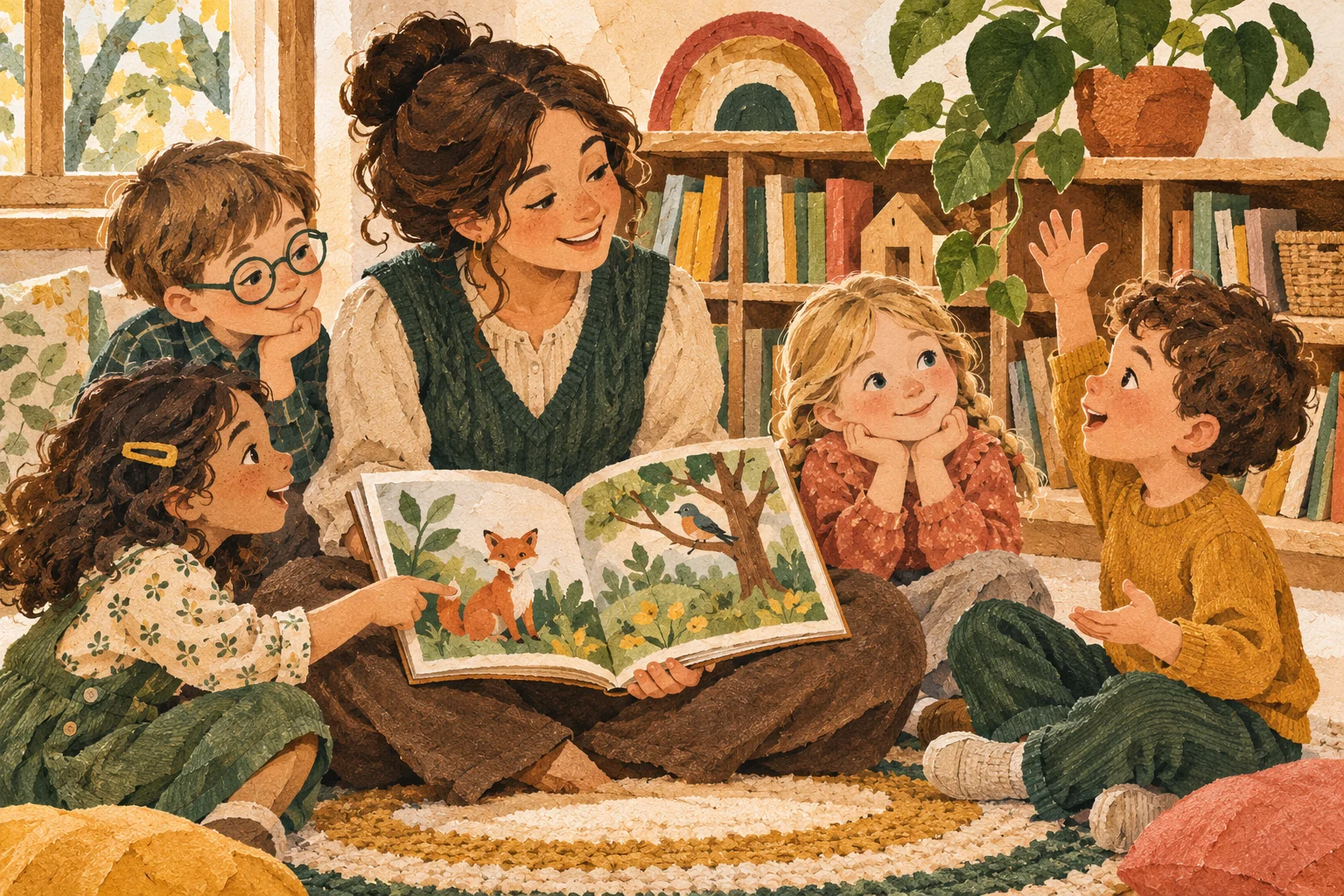
The educator reads aloud to the children every day and talks with them about the book. Let’s make it a duty in every kindergarten in Ukraine.
Appeal · Why kindergarten
Kindergartens are the only managed analogue zone where we can read with children systematically.
Appeal · Personal experience
Three months of daily read-aloud is enough to make even a two-year-old fall in love with books.
I see this in my own children: in a children’s shop they run first to the book department. Modern books are so expressive and well thought out that they easily win the competition for a child’s attention.
Appeal · What the petition proposes
As taxpayers, we already pay for the educators’ work.
The petition proposes that on every working day of the group the educator reads aloud to the children and discusses books. The educator chooses the duration according to the children’s age, needs and condition. The reading and discussion happen within paid working hours, without lengthening the working day.
Appeal · Why kindergarten
In preschool age children form their basic habits, and their brain is actively developing. This is the best time to change the fate of future generations and of our country.
I say this without pathos. Kindergarten is the one analogue zone where we still manage the daily routine. We already pay for the educators’ work, so we can include reading in the schedule. Every day the educator opens a book, reads aloud to the children and discusses what was read with them. Every child gets this experience.
Appeal · Reading and play
In preschool age children play a lot. I see how, after a book is read, they invent games and compose their own stories.
The book gives them ideas for creativity and awakens curiosity.
Appeal · Reading and speech
The strongest predictor of how deeply a 15-year-old will understand complex texts is the richness of oral vocabulary, the complexity of syntax and the skill of oral retelling (narrative) at ages 3–5, as well as shared dialogic reading aloud with an adult.
01 Every day
02 Aloud, with the educator
03 For every child in the kindergarten
Why we start with preschool
Only the kindergarten network makes it possible to create a shared, managed analogue zone for children at national scale: daily time for books, play and live conversation without screens.
Every child who goes to kindergarten gets this opportunity, regardless of parents’ employment, family income or books at home.
Reading together and talking about the story awakens the thirst for knowledge and develops critical thinking. A child learns to ask questions, look for explanations and justify their own opinion.
Why kindergartenPISA-2025
of teenagers in the 17 regions of Ukraine covered by the survey did not reach the basic level of reading literacy.
Ukraine’s average reading score is 418, the OECD average is 461. The difference is about two years of schooling.
Source: OECD, PISA-2025What we ask to change
We ask the Cabinet of Ministers to oblige kindergartens to read aloud to children every day. Three additional decisions define how it will work.
Exact wording of the demandsIn every group, on the days it works, in kindergartens of all forms of ownership. After reading — a conversation about the book, getting to know letters and independent reading, according to the child’s age and readiness.
Additional decisions
Reading is part of the daily routine and paid time. The educator chooses the books, the duration and the way. Children join without coercion.
The institution and its founder are responsible for the books, including in accessible formats. You can start with the existing collections. No contributions from parents.
Check whether reading happens every day and what it gives the children. On a sample basis, without new logbooks, photo or video reports.
A simple question
is where one’s own thinking begins.
What live reading looks like
New words, unfamiliar characters, a twist in the plot.
What happens next? What would we do? Every guess is a reason to talk.
We return to the book, check our guesses, justify our own opinion.
How long to read is up to the educator. The petition sets no norm in minutes.
Scientific basis
Researchers counted words and tested the speech of thousands of children.
One book a day — and by the age of five a child hears 290,000 more words. A meta-analysis of 19 studies: shared reading improves language and comprehension.
These studies concern reading in the family. The effect in kindergartens should be assessed separately.
Logan et al., Journal of Developmental & Behavioral Pediatrics, 2019 Dowdall et al., Child Development, 2020 All studies and international examplesAnswers to questions
Six questions that parents and educators ask.
Yes. The educator reads aloud, shows the pictures and talks with the children. Letters and independent reading come when the child is ready.
There is no norm in minutes. The educator chooses the duration according to the age and condition of the group. The main demand is one: read every day.
No. The kindergarten and its founder are responsible for the books. Help from families is voluntary and does not affect the child’s participation.
Through accessible books and ways of communicating: sign language, tactile books, communication cards. The child answers with a gesture, a look or by choosing a picture. An oral answer is not required.
No. Accessibility tools and remote communication support live interaction. Entertainment video does not replace it.
No. No new logbooks, photo or video reports. The practice is assessed on a sample basis, on representative samples of kindergartens and children.
For parents and loved ones
A book, your voice and ten minutes together. Start today with a story your child is interested in.
Let the child pick the book and leaf through the pages.
Pauses, pictures, favourite stories again and again.
Ask what the child noticed. Listen to their questions.
Practical advice
How to start, what to ask, which book to take and what to do about screens.
Open advice for parentsCommunity
Book finds, educators’ experience, questions about the initiative.
Go to the forumJoin the initiative
Preparing the campaign
The idea needs people who will explain it, unite supporters and prepare the campaign. Choose a contribution that fits your experience and time.
The evangelist role
Explain why a kindergarten needs daily reading and help people find their own way to support it.
Check the explanations, add to the answers, share examples of live reading.
Make the appeal clear to different audiences and media.
Format, venue, coordination of tasks and events.
Expertise, a venue, production of materials, spreading the word after the launch.
Where to start
The result, the deadline, one-off or regular. We will agree on the rest.
I want to help the initiative for daily live reading.
I can take on: …
I offer to prepare: …
I am ready to join in the following time frame: …
Sharing materials
Read aloud to children every day in every kindergarten in Ukraine.